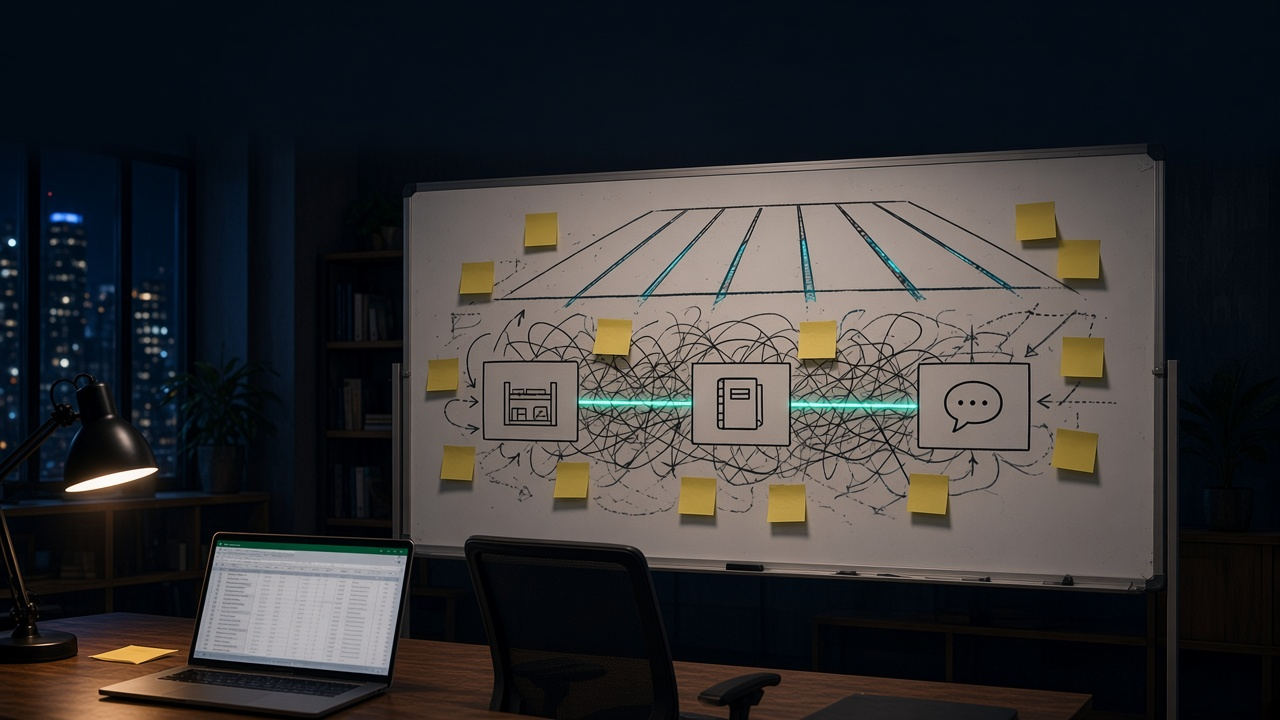
There’s a person on every ops floor who doesn’t show up as the owner of a process, and somehow owns half the company’s Tuesday.
They aren’t the VP. They aren’t the system admin. Their title might say coordinator, specialist, analyst, or something so vague it fits whatever fell through the cracks this quarter. Ask who makes the exception queue move when the ticket system lies, and people point at them without looking up from their screens.
When they’re out sick, Slack gets louder and slower at the same time. When they quit, someone discovers three folders, two spreadsheets, and a mental map of who actually answers after 4 p.m.
AI agents don’t replace people. They replace the process nobody owns.
That line is easy to print on a slide. Living it means admitting most “AI workforce” talk aims at the wrong target. The useful target is the orphaned middle — coordination work that never got a real owner, a clean system of record, or a backup. The person holding it together is skilled. The process under them is not.
Where the series left us
Playbook #1: most AI strategies fail because they start with technology.
Playbook #2: map the real workflow before you model anything.
Playbook #3: after the map, pick a thin agent surface — don’t give a broken handoff a bot.
This piece is the next turn of that screw. You’ve mapped. You’ve refused to automate fog. Now look at what the fog was made of: chase-work. Status hunting. Re-keying. The ping that only one person knows how to phrase so the warehouse answers. The reconciliation that lives in a head, not a rule.
That’s the process nobody owns. Not “accounts payable.” Not “customer success.” The glue between them.
The middle office that isn’t on the slide
Strategy decks love ends of the value chain. Front office: sell more. Back office: close books. The middle is where work waits — approvals that stall, exceptions that bounce, inventory truth that disagrees with itself, escalations that need three systems and a favor.
Here’s what I’ve seen when teams finally whiteboard that middle.
The official swim lane looks tidy. Request lands. Queue assigns. Specialist resolves. Done.
The real path has a human middleware layer. Someone notices the ticket aged past four hours because they check a personal view nobody else has. They Slack the shift lead because email dies on nights. They open the Sheet that still carries “real” quantity, compare it to the WMS, and decide whether to bother finance yet. They draft the customer note in a tone that won’t start a fight. None of that is in the SOP. All of it is load-bearing.
Call that person Maria for a minute. Maria isn’t the agent use case. Maria is proof the process is unowned. Her calendar is full of motion that should be boring and isn’t: dig, compare, nudge, translate, escalate, re-key, confirm. The organization pays her salary for judgment and burns half her week on being the bus between tools that don’t talk.
I’ve watched leaders talk about “AI replacing roles” while Maria’s queue grows. Wrong axis. The role isn’t the waste. The unowned coordination is.
A morning that looks like progress and isn’t
Same ops world as the earlier pieces. Fulfillment exceptions again, because that’s where honesty shows up fast.
Monday, 9:40 a.m. Shortage on an order that already has a customer waiting. WMS says 12. Sheet says 4. CS needs language. Warehouse needs a pick decision. Planner is in a meeting. Maria does what she always does.
She opens three tabs. Copies the order ID into chat. Asks the floor if the cycle count finished. Pastes a draft reply for CS to send later. Updates her tracker so finance doesn’t ask twice. Flags the substitute question for the senior planner. By 10:15 the fire is quieter. By 10:16 the next one is already aging.
Now put a naive agent on “Maria’s job.”
It summarizes tickets. It drafts emails. It even “routes” substitutes if someone was careless with permissions. Volume looked better in the pilot dashboard. The Sheet grew two columns to catch what the agent got wrong. Maria still reconciles truth. CS still waits on tone. The planner still owns the call nobody wrote down. You didn’t replace Maria. You gave the orphan process a louder mouthpiece.
The agent surface that actually helps looks less like a job description and more like stealing Maria’s Tuesday morning chores once the path is honest enough:
Watch exception age and surface anything stuck past the threshold, with the fields a human would hunt for.
Pull WMS qty and Sheet qty side by side while the Sheet still exists, so the disagreement is visible without Maria opening both.
Draft the customer update for human send — never auto-send on shortage while inventory truth is split.
Route the ping to the named backup when the shift lead is offline, after that backup has access.
Park “substitute requested” for the planner. Don’t approve it while the rule is still tribal.
Motion and memory. Not the contested call. Maria keeps judgment. The orphan chase loses its grip on her week.
That’s replacement of a process, not a person. If your pilot can’t say which orphaned motions it took off a human’s plate — with numbers on chase time, not “engagement” — it isn’t this playbook. It’s decoration.
Why “nobody owns it” is the tell
Ownership on an org chart and ownership on the floor diverge constantly.
Org-chart ownership says Finance owns invoices, Warehouse owns inventory, CS owns the customer. Floor ownership says whoever answers when the three disagree. That person rarely has authority to fix the systems. They have responsibility without a redesign budget. So they invent glue. Glue calcifies into “how we work.” Then someone proposes an AI program aimed at headcount in those departments, and misses the glue entirely.
Agents are good at glue when glue is rules-plus-motion on a path you’ve stabilized. They’re bad at politics. They’re bad at access rights. They’re bad at deciding which of two truths is real when leadership never picked.
So the operator test is blunt: name the process that only works because a specific human refuses to let it die. If you can’t name it, you aren’t ready to agent-ify the middle. If you can name it, ask whether you’re about to automate their judgment or their chase-work. Only one of those is fair game early.
Concession where it’s earned: some teams have already killed the orphan. Single system of record, written exceptions, backups with access, metrics on queue age. For them, the agent surface can widen. Most teams I sit with are still one PTO week away from discovering who their Maria is. Pretending otherwise is how you get a chatbot that performs empathy while the Sheet stays load-bearing.
What to put on the agent vs. what stays human
I won’t dress this up as a five-step framework. You’ve seen enough checklists in this series. The sorting lens is simpler, and it only works after the map from Playbook #2 and the surface honesty from #3.
Give the agent the parts of the orphan process that are repeatable once truth is named: watching age, gathering context across the systems that actually matter, drafting the note a human will send, routing to the right queue when rules are written, flagging the odd case with evidence instead of vibes.
Keep humans on the parts that were never process — they were trust. Granting access. Choosing which system wins when numbers disagree. Approving the substitute that isn’t in the rulebook. Anything you’d hesitate to put in writing for an auditor. Anything that only works because Maria knows whose day not to ruin.
If you reverse that split, you get confident automation on contested calls and humans still doing the dig work at 9:40 a.m. That’s the failure mode that makes people say “AI doesn’t work in ops.” AI was pointed at the wrong layer.
Implications that show up in the calendar, not the demo
When this lands, calendars change before titles do.
Maria’s Tuesday stops being a scavenger hunt. She spends more time on exceptions that deserve a human and less time proving the WMS and the Sheet still disagree. CS gets drafts that already include the fields they used to chase. The planner sees substitute requests with evidence instead of a Slack wall. Nobody announces a layoff. Throughput on the orphan path improves because the path finally has motion that doesn’t depend on one person’s inbox vigilance.
The quieter signal is backup resilience. If the agent watches age and routes to a named backup with access, PTO stops being an outage. That’s the test I care about more than demo polish. Can the middle keep moving when Maria is offline, without inventing a new hero?
I’ve also seen the false win: dashboards that count “agent-handled interactions” while chase-work merely moved into prompt-tuning and spreadsheet cleanup. Measure human time on dig-and-ping. Measure queue age. Measure how often systems disagree and how long disagreement sits. If those don’t move, the process still has no owner — you’ve just hired a model into the same fog.
How this sits with the fear conversation
People hear “agents replace” and reach for headcount. Fair. Vendors sell that story. Boards ask for it. Operators know the floor story is different: skilled people drowning in unowned coordination while strategy decks argue about roles.
Stabilizing handoffs and handing chase-work to an agent is how you stop burning operators on glue. It is not a claim that judgment, customer trust, or exception craft are obsolete. Those get more room when the orphan process stops eating the week.
If a program’s first slide is an org chart with X’s on boxes, ask what orphaned motions were measured first. If the answer is vibes, you’re not in this playbook yet. Map. Stabilize. Thin surface. Then take the process nobody owned — carefully — and leave the people who were holding it room to do the work that actually needed them.
The question worth sitting with
You already know who your Maria is. You might even be them.
The next useful move isn’t a tool bake-off. It’s naming the orphan process out loud: the chase, the re-key, the status hunt, the ping path that only works because one person knows the tribal map. Mark which of those motions could sit on a green agent surface tomorrow, and which still need a human because truth or rules aren’t honest yet.
In a later piece I’ll stay in this neighborhood — money that actually showed up when the middle stopped depending on heroics, and money that didn’t. For now, one operator filter:
If the only reason the middle works is a person, you don’t have a staffing plan. You have an unowned process wearing a name badge.
What process in your shop only survives because someone refuses to let it die — and which part of that survival is chase-work you could finally put under a system?