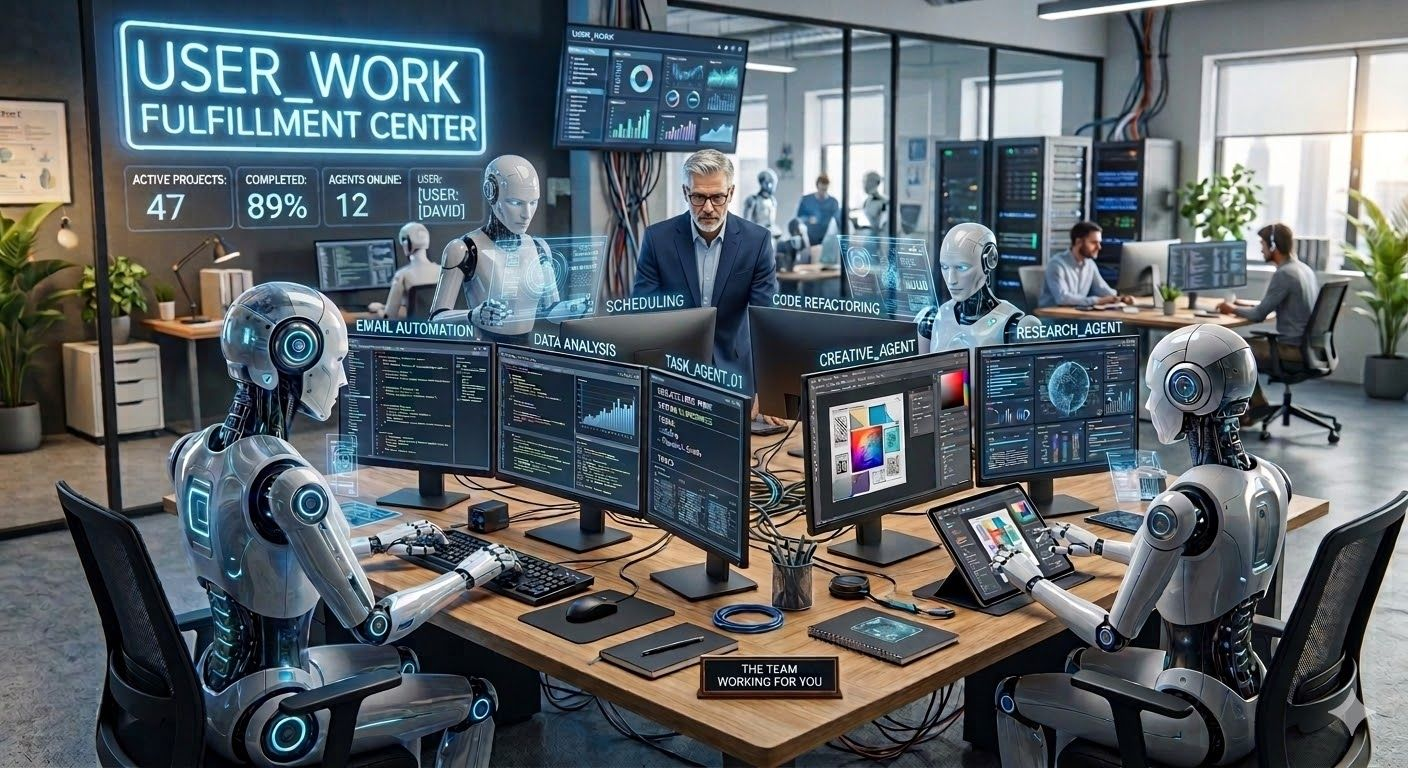
This image isn’t science fiction. It’s a roadmap.
We’re already living in the early version of this — AI agents handling email automation, data analysis, code refactoring, scheduling, and research simultaneously. Around the clock. Without fatigue. Without PTO requests. Without the Monday morning ramp-up.
But here’s what most people aren’t talking about yet: the next frontier isn’t just digital labor. It’s physical.
From Browser Tab to Warehouse Floor
Right now, AI agents live inside your software stack. They’re API calls. Background processes. Copilots riding shotgun in your IDE or your inbox. Useful — sometimes remarkably so — but fundamentally confined to the digital world.
That confinement is temporary.
The same large language models powering your coding assistant are being wired into robotic systems with computer vision, spatial reasoning, and fine motor control. The agent that today refactors your codebase will, in the near future, walk the warehouse floor. Inspect the job site. Pull the server rack. Greet the customer at the door.
This isn’t a decade-out prediction. Companies like Tesla, Figure, and Boston Dynamics are already building the body to match the brain. Figure’s humanoid robots are operating in BMW manufacturing facilities. Tesla’s Optimus is performing repetitive warehouse tasks. Boston Dynamics’ Atlas can navigate unstructured environments that would challenge most humans.
The convergence is happening faster than the industry realizes, because the hard part — general intelligence and reasoning — is already further along than the hardware. The body is catching up to the brain, not the other way around.
The Shift Nobody’s Org Chart Is Ready For
When I talk to enterprise leaders about AI adoption, the conversation almost always centers on software: which LLM to use, how to build a chatbot, where to deploy copilots. That’s Year 1 thinking.
The Year 3 conversation — the one almost nobody is having — is about workforce architecture. Not “how do we use AI tools?” but “how do we design workflows for a team that’s half human, half agent?”
This is a fundamentally different question. It changes:
How you hire. The premium shifts from “can this person do the work?” to “can this person orchestrate agents doing the work?” The best manager of the future won’t be the one who’s great at the task — they’ll be the one who’s great at decomposing the task into agent-executable steps and handling the exceptions.
How you organize. Your org chart today has people and titles. The org chart of the future will have agents and roles. Some roles will be filled by humans. Some by agents. Some by a human-agent pair. The organizational design skill that matters most will be knowing which is which.
How you measure. Productivity metrics built for human workers break down when half your “workforce” operates 24/7 without breaks. Output-per-hour becomes meaningless when the hour is always available. The new metrics will center on orchestration efficiency: how well does the human layer direct, correct, and amplify the agent layer?
Three Truths About the Human-Agent Workforce
After 20+ years building enterprise systems — watching every technology wave promise to “change everything” and then land somewhere more nuanced — here’s what I believe is actually true about this one:
1. The Competitive Moat Belongs to Orchestrators
The advantage won’t go to companies with the most agents. It’ll go to companies whose people know how to orchestrate agents effectively.
Think about it like a fulfillment center. The competitive advantage of Amazon isn’t that they have robots — every major logistics company has robots now. It’s that Amazon’s systems for coordinating robots, humans, and software are better integrated than anyone else’s.
The same principle applies to AI agents in knowledge work. Every company will have access to the same foundation models. The differentiation will be in the orchestration layer: the workflows, the handoff protocols, the exception handling, the human judgment applied at the right moments.
This is why I keep telling enterprise architects: stop thinking about AI as a tool. Start thinking about it as a workforce layer that needs the same kind of operational design you’d give to any team.
2. Human Value Concentrates in Judgment, Accountability, and Creativity
Agents can execute. They can even reason. What they can’t do — and won’t for a meaningful period — is bear accountability.
When an AI agent makes a recommendation that loses a client, nobody sues the agent. When a robotic system makes a decision that affects worker safety, the accountability still sits with a human. This isn’t a technicality — it’s a structural feature of how businesses, regulations, and society operate.
That means the human role shifts from doing to deciding. From execution to judgment. From “I wrote this report” to “I reviewed the agent’s analysis, applied context the agent doesn’t have, and made the call.”
This is actually a better version of most knowledge work jobs. The tedious parts — the data gathering, the first drafts, the formatting, the scheduling — get handled by agents. The interesting parts — the strategy, the relationships, the creative leaps, the hard calls — stay with humans.
But only if organizations intentionally design it that way. Left to default, what actually happens is companies layer agents on top of existing workflows without redesigning anything, and you get the worst of both worlds: humans babysitting agents instead of being freed by them.
3. The Physical Crossover Changes the Stakes
When AI agents were confined to software, the disruption — while significant — was bounded. An agent that writes bad code produces a bug. An agent that sends a bad email creates an awkward conversation. The blast radius of failure is manageable.
Physical AI changes the stakes entirely.
An agent that makes a bad decision on a warehouse floor can injure someone. A robotic system that misreads its environment can damage equipment worth millions. The intersection of AI reasoning and physical action introduces failure modes that pure-software AI never had to worry about.
This is why the orchestration layer matters so much. The humans in the loop aren’t just there for quality control — they’re there because the consequences of unsupervised physical AI are categorically different from unsupervised digital AI.
Companies that treat physical AI deployment with the same casualness as deploying a chatbot are going to learn expensive lessons.
What This Means for Right Now
You don’t need to wait for humanoid robots to start preparing. The organizational muscles required for a human-agent workforce are the same ones you should be building today:
Start decomposing workflows into agent-eligible and human-required steps. Not every task in a workflow needs a human. Not every task can be safely delegated to an agent. The act of mapping this boundary — for every critical workflow in your organization — is the single most valuable exercise you can do right now.
Invest in orchestration skills, not just AI skills. “Prompt engineering” is table stakes. The real skill gap is in workflow design: understanding how to break complex processes into steps, define handoff criteria between human and agent, and build feedback loops that catch errors before they compound.
Design for the hybrid state, not the end state. We’re not going from “all human” to “all agent.” We’re going to live in a hybrid world for a long time — probably permanently. The organizations that design for hybrid from day one will outperform those trying to retrofit it later.
Take physical AI seriously, even if you’re a knowledge-work company. Your office building, your data center, your supply chain — all of these will be touched by physical AI within the next five years. Understanding the intersection of digital intelligence and physical systems isn’t optional, even if you think of yourself as a “software company.”
The Fulfillment Center Is Already Being Staffed
Look at the image at the top of this article again. A human standing in the center, surrounded by agents handling specialized tasks. Active projects tracked. Completion rates monitored. Each agent focused on what it does best — email, data, scheduling, code, research, creative work — while the human provides direction, judgment, and accountability.
This isn’t a vision of 2035. This is a realistic depiction of how leading-edge teams operate right now, with the agents still purely digital. The physical versions are being built in labs today and will be in warehouses and offices within a few years.
The question isn’t whether this is coming. It’s been coming for a while, and the early innings are already being played.
The question is whether your organization is designing workflows for a world where your workforce is half human, half agent. Because the companies that figure out that orchestration — that learn to blend human judgment with agent execution across both digital and physical domains — will have a structural advantage that’s very hard to replicate.
The fulfillment center of the future is already being staffed. The only open question is who’s doing the staffing — you, or your competition.
Originally shared as a LinkedIn post. Follow me there for weekly insights on AI, enterprise architecture, and the future of work.