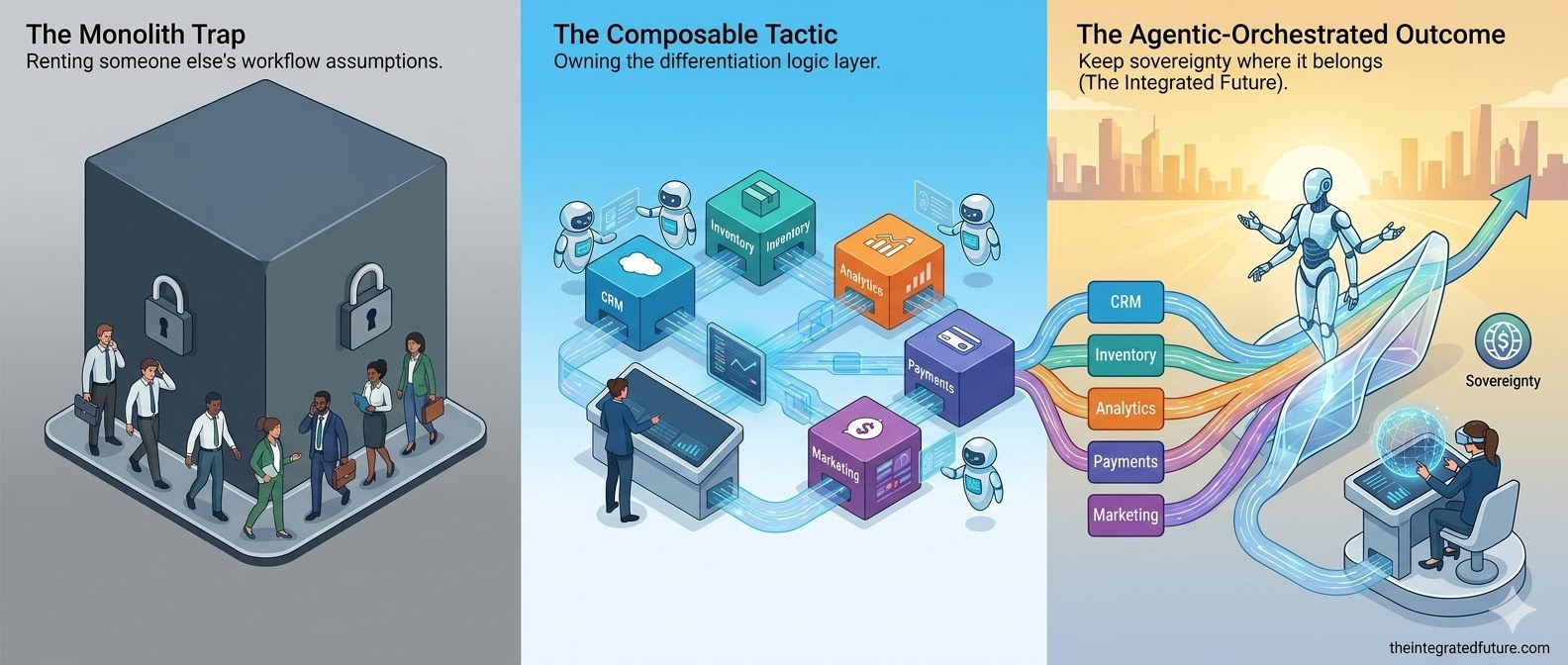
There’s a sentence I’ve heard in every enterprise I’ve ever worked inside or consulted for. It sounds harmless. It’s usually said with a shrug, maybe a half-laugh:
“We had to change our process to fit the tool.”
I’ve been an enterprise architect for more than a decade. I’ve watched that sentence do more damage to operational effectiveness than any technology failure, any bad deployment, any missed deadline. Because it represents something most companies never consciously decided: the moment they handed their operational decision-making to a vendor’s product team.
The Invisible Handoff
When you sign a SaaS contract, you think you’re buying capability. A CRM. A project management platform. An ERP module.
What you’re actually buying is a set of opinions. The vendor’s opinion about how data should be structured. Their opinion about what workflows matter. Their opinion about which integrations deserve first-class support and which ones get a clunky API and a prayer.
These aren’t neutral decisions. They’re business model decisions made by people who’ve never seen your operation.
And the moment your team starts bending their processes to fit inside those opinions, you’ve made an invisible trade. You traded operational sovereignty for convenience.
The Real Cost of Lock-In
Most conversations about vendor lock-in focus on switching costs. Migration complexity. Data portability. Renewal leverage.
Those are real. But they’re not the expensive part.
The expensive part is what happens to your team’s thinking. When the system doesn’t support something, people stop asking for it. When the workflow is rigid, operators stop imagining alternatives. When every new need requires a vendor feature request and a 12-month roadmap wait, your organization learns a dangerous lesson: the software decides what’s possible.
That’s not a technology problem. That’s a culture problem wearing a technology mask.
I’ve seen teams spend months building elaborate workarounds inside a monolithic platform — duct-taping Zapier automations, maintaining shadow spreadsheets, writing custom middleware to make one part of the system talk to another part of the same system. Ask them why, and the answer is always the same: “The tool doesn’t do it the way we need.”
The irony is brutal. You’re paying for a system that doesn’t fit, then paying again to make it almost fit, and calling that a technology strategy.
The Vendor’s Incentive Problem
Here’s the part that makes the monolithic SaaS model structurally broken, not just inconvenient.
The vendor’s incentive is to expand their surface area. More features. More modules. More reasons for you to stay. Their product roadmap is a retention strategy, not an operations strategy.
When Salesforce adds project management, they’re not doing it because they believe it will make your operations better. They’re doing it because every workflow you move into their platform increases your switching cost.
That’s not malicious. It’s just business. But it means the system guiding your operations is being built to serve someone else’s business model. Every time a monolithic platform ships a new module that’s 70% as good as the purpose-built alternative, they’re betting you’ll accept “good enough” in exchange for the comfort of not having to integrate.
And for a long time, that bet paid off.
The Composable Alternative
The alternative isn’t “build everything from scratch.” That’s the false binary the SaaS industry wants you to believe in — because it makes “buy our platform” sound like the only sane option.
The real alternative is composable. It looks like this:
Rent what’s commodity. Compute. Storage. Infrastructure. Authentication. These are solved problems. Don’t rebuild them. Don’t even think about them.
Own what’s differentiating. Your business logic. Your workflow rules. Your data relationships. The decisions about how your specific operation runs. These should live in systems you control, not inside a vendor’s opinionated data model.
Assemble purpose-built systems. Instead of one monolithic platform that does 15 things at 70%, connect specialized tools that each do one thing at 95%. A composable architecture lets you swap components without rewiring your entire operation.
Keep decision sovereignty with operators. The people closest to the work should decide how the work gets done. Not a product manager in San Francisco who’s never set foot in your warehouse, your call center, or your field operation.
What This Looks Like in Practice
This isn’t theory. I’ve spent more than a decade inside one enterprise watching the difference between monolithic and composable play out in real time.
The monolithic deployments always start fast. A vendor flies in, configures the platform, and does a big go-live. Twelve months later, the workarounds start. Eighteen months later, someone builds a shadow system. Two years in, you’re spending more on customization and integration than you spent on the original license — and you still can’t get the data where you need it.
The composable approach starts slower. You have to think harder about what you actually need. You have to design the integration layer. You have to make explicit decisions about where data lives and how it moves.
But two years in, you can change things. You can swap a component. You can add a new capability without a six-month vendor engagement. You can respond to a business change in weeks, not quarters.
That’s the real ROI of composable: not lower cost, but higher adaptability. In a world that changes as fast as this one, adaptability is the only durable advantage.
AI Just Changed the Math
For years, the composable approach had one legitimate weakness: the integration tax.
Connecting purpose-built systems meant middleware, custom glue code, data mapping, and dedicated teams to maintain it all. That overhead was real, and it was the monolithic platform’s strongest selling point. “Sure, we’re only 70% as good at each thing — but at least it all talks to each other.”
That argument is collapsing.
AI — specifically agentic AI — is rewriting the economics of integration. Agents can now orchestrate workflows across system boundaries. They can map data between tools that were never designed to work together. They can monitor, adapt, and route work across a composable stack with a fraction of the human overhead that integration used to demand.
Think about what that means for the monolithic value proposition. If the main reason you accepted one vendor’s opinion about everything was because connecting best-of-breed tools was too painful, that pain is evaporating.
The integration layer — the one thing that made monolithic platforms defensible — is becoming an AI-native capability. And unlike a vendor’s rigid connector library, an agentic integration layer learns, adapts, and scales with your operation instead of constraining it.
This is the moment the calculus flips. The cost of composable just dropped dramatically. The cost of monolithic — measured in lost adaptability, vendor dependency, and operational rigidity — hasn’t changed at all.
The companies that see this shift early won’t just have better technology. They’ll have something more valuable: the ability to change faster than their competitors, because they never outsourced their operational decisions to a vendor’s product roadmap in the first place.
The Monolithic Era Is Ending
Every time your team says “we had to change our process to fit the tool,” ask yourself: who’s actually making the operational decisions here?
If the answer is a vendor’s product roadmap, you have a bigger problem than software selection. You have a sovereignty problem.
The companies that thrive in the next decade will be the ones that figure this out early. Who stopped renting someone else’s opinion about how their business should run. Who built the muscle to assemble, adapt, and own their operational architecture.
The monolithic era is ending. Not because the technology failed — but because the model was always designed to serve the vendor, not the operator.
The question is whether you’ll realize that before or after your next renewal.